The station that put Black Atlanta on the air

Old Atlanta Weekly · Issue 03

Old Atlanta collage with city streets, skyline, a record, and a vintage microphone

Before Black radio became a national industry, WERD proved that ownership could turn a local signal into cultural power.

September 2026 · History, music & memory

Ownership changed the signal.

The cover story / Radio & culture

Before “Black radio” became a national industry, WERD proved that ownership could turn a local signal into cultural power.

In 1949, Atlanta woke up to a different kind of radio station. WERD already existed as a small station, but its new owner, Jesse B. Blayton Sr., changed who controlled the microphone, who worked behind it and whose daily life counted as news.

Blayton was an accountant, Atlanta University professor and bank president. He paid $50,000 for the 1,000-watt station and placed it in the Prince Hall Masons Grand Lodge on Auburn Avenue. Other stations had already experimented with programming for Black audiences. WERD’s breakthrough was ownership: it became the first American radio station owned by an African American.

That distinction changed the institution from the inside. Blayton hired his son Jesse Jr. as station manager. The younger Blayton brought in veteran announcer Jack Gibson and replaced the remaining all-white announcing staff with Black professionals. WERD’s celebrated “Four Horsemen”—Gibson, Joe Howard, Roosevelt Johnson and Jimmy Winnington—mixed music with church services, public affairs, education and community information.

Blayton also hired Ken Knight as program director, building a team that could decide how Black Atlanta sounded instead of simply performing inside somebody else’s format. That control mattered. A station schedule is a map of whose work, worship, politics and pleasure deserve public attention. At WERD, local voices could move from the margins into the normal rhythm of the broadcast day. The station did not have to treat Black life as an occasional special program; it could make the community the organizing principle of the entire service.

Gibson, known first as “Jockey Jack” and later as “Jack the Rapper,” understood that a disc jockey could be more than a voice between records. His personality helped make WERD commercially viable while giving Atlanta listeners a sound shaped for them rather than merely sold to them. He became one of the city’s leading radio personalities.

The address amplified the station’s influence. Prince Hall’s building stood in the heart of Sweet Auburn, surrounded by Black banks, newspapers, insurance companies, churches and professional offices. The Southern Christian Leadership Conference later worked in the same building. One often-told story says Martin Luther King Jr. signaled the studio from below when he needed airtime and a microphone was lowered from an upstairs window. Whether every detail of that story can be documented or not, the larger relationship is clear: WERD carried civil-rights information and placed movement voices directly before Black listeners.

The station was also a business lesson. Black performers gained airplay; Black-owned businesses could advertise to customers who had often been ignored by mainstream media; and Black announcers gained a professional platform. WERD treated the audience as citizens, consumers and makers of culture all at once.

Blayton sold the station in 1968, and the original WERD era ended soon afterward. Its influence did not. Gibson helped build the Black radio and music-business networks that followed, while the Prince Hall building remained a physical reminder of how tightly Atlanta’s business, cultural and political institutions were connected. WERD’s signal was modest. Its idea was enormous: Black Atlanta should not merely appear on the air—it should own the station.

The station upstairs, the movement downstairs

Hidden Atlanta

Prince Hall’s lodge was more than WERD’s address. The building gave Black organizations secure, centrally located rooms in a segregated city. Its tenants included a Madam C. J. Walker beauty school, WERD and, during the 1960s, the Southern Christian Leadership Conference.

That proximity collapsed the distance between organizing and broadcasting. Announcements could move from a meeting room to the air, while music and community news brought listeners back throughout the day. The building itself became communications infrastructure.

Atlanta made data beautiful before dashboards

Data as design / 1900

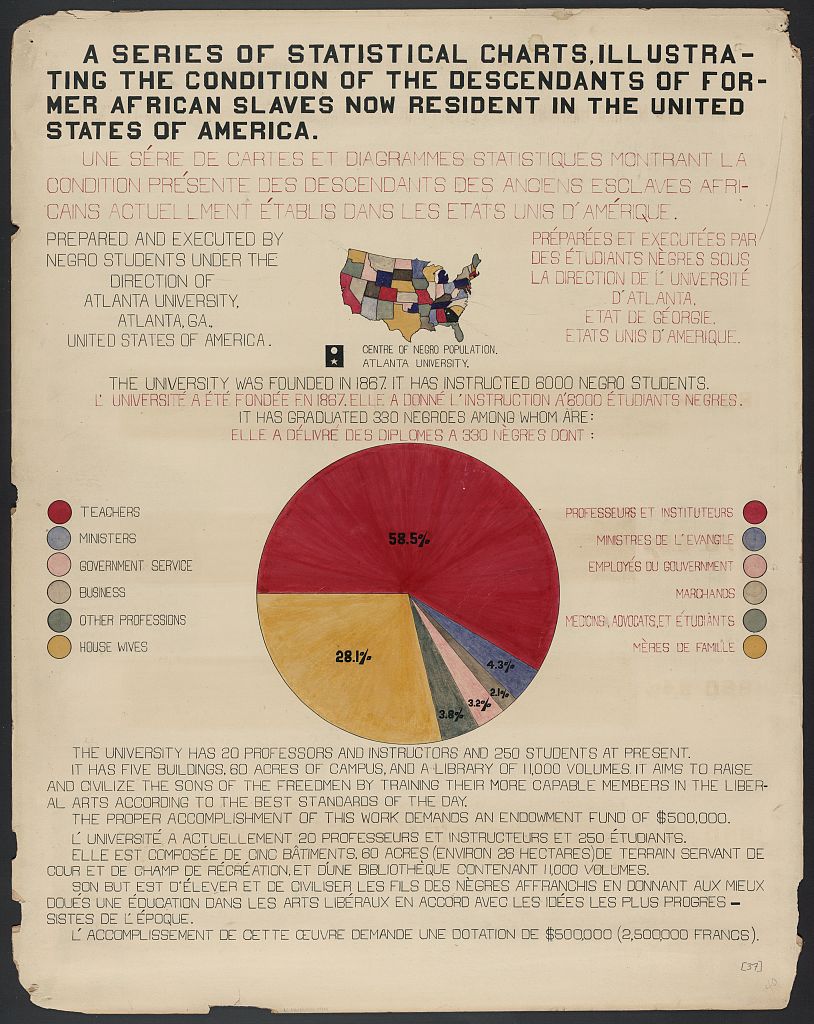
Atlanta University statistical chart from the 1900 Paris Exposition
Statistical chart prepared by Atlanta University students for the Negro Exhibit at the 1900 Paris Exposition, under the direction of W. E. B. Du Bois. Library of Congress, Prints and Photographs Division, digital ID ppmsca.08994. Public domain in the United States.

In 1900, W. E. B. Du Bois and Atlanta University students prepared photographs, maps and boldly colored statistical charts for the Paris Exposition. Their evidence challenged racist claims by documenting Black education, work, property and social progress three decades after emancipation.

The designs feel startlingly modern—circles, bars and fields of color used to make social facts visible at a glance. Atlanta was not simply the subject of the research; its university community helped invent a visual language for presenting Black life to the world.

When washerwomen used a world’s fair as leverage

Labor & community / 1881

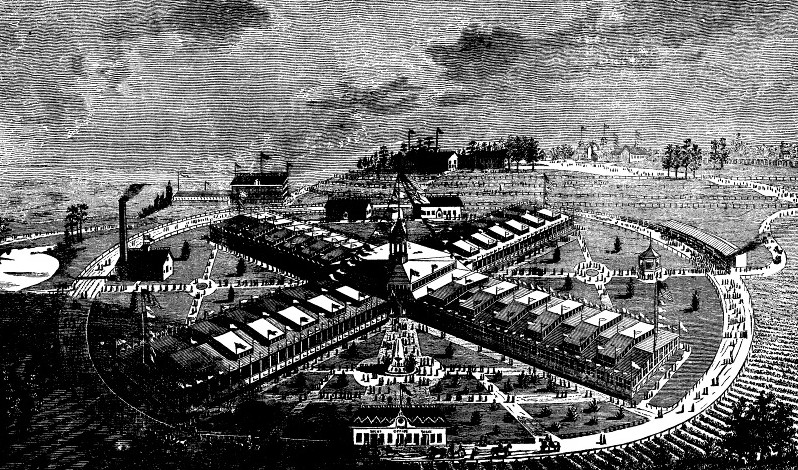
A contemporary rendering of Atlanta's 1881 International Cotton Exposition
Contemporary rendering of Atlanta’s 1881 International Cotton Exposition, published in Manufacturer and Builder, October 1881. Public domain in the United States; digitized copy via Wikimedia Commons.

In July 1881, twenty Black laundresses organized Atlanta’s Washing Society and demanded a uniform rate of one dollar per twelve pounds of laundry. Within weeks, the movement counted roughly 3,000 members and threatened to disrupt the city just as leaders prepared for the International Cotton Exposition.

Officials answered with arrests, fines and a proposed license fee. The women countered that they would pay the fee if it protected their right to control the trade. Their campaign revealed how much Atlanta’s celebrated “New South” depended on Black women’s labor—and how collective action could make that dependence visible.

What might you have heard on WERD?

Atlanta time capsule

Rhythm and blues, jazz and gospel shared the schedule with church services, educational programs, public affairs and neighborhood news. The mix made WERD useful as well as entertaining: listeners could hear artists ignored elsewhere, learn what was happening around Auburn Avenue and receive information from institutions they trusted.

That blend became a template for Black-oriented radio around the country. The format recognized that a community was not a niche genre—it was an audience with a full civic and cultural life.

From the archive to the record.

The city keeps creating

Visit The Real Atlanta Store

What did Atlanta radio sound like in your house?

Your Old Atlanta

Share the station, announcer, song, church broadcast, advertisement or neighborhood announcement you still remember. Photographs, recordings, programs and oral histories are welcome.

Old Atlanta collage of city lights, vinyl records and music culture